Personal Finance – India
New Gratuity Rules 2025: 4 Things Every Salaried Employee Must Know
India’s new Labour Codes, effective 2025, have changed how gratuity is earned, calculated and paid, especially for fixed-term employees and high CTC earners.
Why these new gratuity rules matter in 2025
The updated Labour Codes reshape gratuity eligibility, link it tightly to your CTC structure, and enforce stricter timelines for employers to pay.
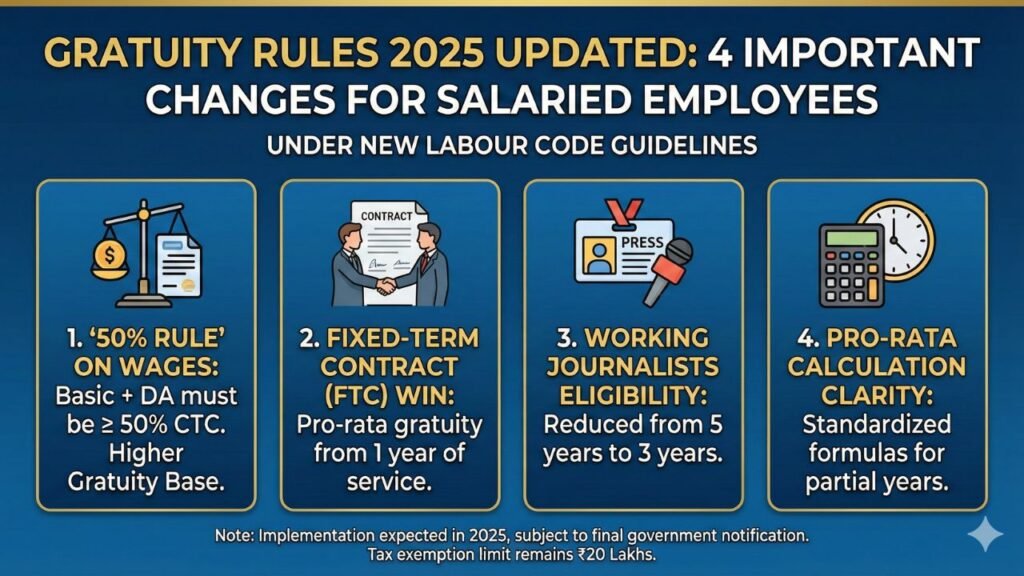
- ✔ Fixed-term employees can now qualify for gratuity after just 1 year of continuous service instead of 5 years.
- ✔ A new, uniform wage definition links gratuity to at least 50% of total remuneration, potentially increasing payouts.
- ✔ Employers must clear gratuity within a set timeline or pay interest, which strengthens employees’ rights.
Snapshot: New Gratuity Rules 2025
- Law in force 4 Labour Codes 2025
- 1-year eligibility Fixed-term only
- Wage base ≥ 50% of CTC
- Tax status Partially tax‑free
Table of Contents
Jump to section
- What is gratuity under Indian law?
- Overview of the 2025 gratuity changes
- Rule 1: 1-year eligibility for fixed-term employees
- Rule 2: New wage definition and impact on CTC
- Rule 3: Gratuity calculation formula in 2025
- Rule 4: Payment timelines, caps and tax benefits
- Checklist: What salaried employees should do now
- Quick FAQs on new gratuity rules 2025
What is gratuity under Indian law?
Gratuity is a one-time lump sum benefit employers must pay eligible employees as a reward for long and continuous service, governed by the Payment of Gratuity Act, 1972 and now integrated with the Code on Social Security under the new Labour Codes.
The law covers establishments with at least 10 employees and applies across factories, shops, IT companies, and most organised sector employers in India.
Key concept
Who is generally covered?
Any employee (permanent or fixed-term) working in an eligible establishment that meets the minimum employee threshold can be covered under gratuity rules.
Why it matters
Why gratuity is important
Gratuity acts as a retirement and job-transition cushion that grows quietly in the background with every completed year of service, without any active contribution from the employee.
Overview of the 2025 gratuity changes
In 2025, the Government implemented four consolidated Labour Codes—on Wages, Industrial Relations, Social Security, and Occupational Safety—which together replace numerous older labour laws and harmonise provisions like gratuity, PF and salary structure.
The Code on Social Security and the new uniform wage definition have changed who qualifies for gratuity, how quickly they qualify, and on what salary components gratuity is calculated.
The 4 big gratuity shifts in 2025
- Faster eligibility for fixed-term employees (1 year instead of 5).
- Uniform wage definition across codes with at least 50% of CTC counted as “wages”.
- Gratuity calculated on a higher and more standardised wage base for many employees.
- Clearer payment timelines and interest liability for delayed gratuity, plus continued tax benefits.
Rule 1: 1-year eligibility for fixed-term employees
Under the new Labour Codes, fixed-term employees now become eligible for gratuity after just 1 year of continuous service, compared to the earlier minimum requirement of 5 years for most employees.
This is particularly beneficial for workers in high-attrition and project-based sectors such as IT services, startups, e-commerce, media, and other roles where contracts often end before 5 years.
Good news
Who gets 1-year benefit?
- Employees hired under a fixed-term employment contract directly by the employer.
- Fixed-term roles treated at par with permanent workers for wages and benefits.
Important nuance
What about permanent staff?
For regular permanent employees, the general rule of needing at least 5 years of continuous service for gratuity entitlement broadly continues, except in cases like death or disablement where the five-year condition does not apply.
Practical tip: If you are on a fixed-term contract that will soon complete 12 months, keep documentation ready (appointment letter, salary slips, relieving date) and formally claim gratuity at exit if the employer does not proactively initiate it.
Rule 2: New wage definition and impact on CTC
The Labour Codes introduce a uniform definition of “wages” that now applies across gratuity, PF, bonus, and other social security calculations, with basic pay plus certain allowances required to form at least 50% of total remuneration.
This definition curbs the earlier practice of keeping basic salary artificially low and loading the CTC with allowances, which used to reduce long-term benefits such as PF and gratuity for employees.
New wage definition (simplified)
Wages ≈ Basic pay + Dearness allowance + Retaining allowance
(These together must be at least 50% of total monthly remuneration for benefit calculations.)
Wages ≈ Basic pay + Dearness allowance + Retaining allowance
(These together must be at least 50% of total monthly remuneration for benefit calculations.)
CTC impact
Possible effect on take-home
Many employers will restructure CTC so that at least half of it qualifies as wages, which can increase PF and gratuity contributions but may slightly reduce in-hand salary for some employees.
Long-term gain
Higher gratuity entitlement
Because gratuity is now tied to a more robust wage base, employees who stay longer may receive higher gratuity payouts than under earlier low-basic structures.
Rule 3: Gratuity calculation formula in 2025
The fundamental gratuity formula remains based on last drawn wages and completed years of service, but the 2025 rules change which components are counted into those “wages” for many employees.
For each completed year of eligible service, employees are generally entitled to 15 days’ wages, subject to the overall monetary ceiling prescribed under law.
Standard gratuity formula (for monthly-rated employees)
Gratuity ≈ (Last drawn monthly wages × 15 × Completed years of service) ÷ 26
Here, “wages” is as per the Labour Code definition, not just a low basic figure.
Gratuity ≈ (Last drawn monthly wages × 15 × Completed years of service) ÷ 26
Here, “wages” is as per the Labour Code definition, not just a low basic figure.
Key points
Service period rules
- Only completed years of service are considered, with specific rounding rules for partial years under the Act.
- Fixed-term employees earn gratuity on a pro-rata basis once they complete 1 year.
Eligibility triggers
When gratuity becomes payable
- Superannuation or retirement.
- Resignation after completing the minimum eligible service period.
- Death or permanent disablement (five-year condition waived).
Quick gratuity estimator (for awareness only)
New wage definition
15 days per year
Rule 4: Payment timelines, caps and tax benefits
Employers are required to pay gratuity within a prescribed period—commonly 30 days from when it becomes due—and delays can attract interest liability, payable to the employee.
Gratuity continues to enjoy favourable tax treatment, with a statutory limit on the maximum tax-exempt amount, and any amount beyond that limit treated as taxable income in the year of receipt.
Tax angle
Tax treatment
- Gratuity up to the notified ceiling is exempt for eligible employees, subject to income tax rules.
- Any amount beyond the limit is taxed as per the individual’s slab in the year of receipt.
Employer obligations
Payment timeline & interest
- Gratuity should be paid promptly after it becomes due at retirement, resignation, death, or disablement.
- Delayed payment can attract statutory interest, which increases employer cost and protects employees.
Action point: If your gratuity is not paid within the stipulated period, document all communication and escalate through HR, management, and where needed, statutory authorities or legal channels.
Checklist: What salaried employees should do now
With the New Gratuity Rules 2025 in force, salaried employees should treat gratuity as a core part of their long-term financial planning rather than an afterthought at retirement.
A few practical checks on your CTC, service tenure, and exit strategy can ensure you do not leave money on the table when switching jobs or negotiating new offers.
CTC & offer letters
Review your salary structure
- Ensure at least 50% of your CTC is classified as wages (basic + DA + retaining allowance) in line with the new definition.
- When negotiating new offers, focus not only on take-home pay but also on long-term benefits like PF and gratuity.
Job moves
Time your exits smartly
- Avoid resigning just before completing the minimum gratuity-eligible service (5 years for regular staff, 1 year for fixed-term) where feasible.
- Track your total continuous service if you have internal transfers or mergers to ensure correct tenure counting.
Documentation
Keep records handy
- Preserve appointment letters, revised CTC letters, salary slips, and relieving letters for every employer.
- Use these documents to verify the correctness of the employer’s gratuity calculation at exit.
Financial planning
Integrate with retirement goals
- Treat expected gratuity as part of your retirement corpus along with EPF, NPS, and mutual fund SIPs.
- Plan for the tax impact if your gratuity is likely to exceed the exempt ceiling.
Quick FAQs on New Gratuity Rules 2025
These short answers clarify the most common doubts salaried employees have about the updated gratuity framework under the Labour Codes.
FAQ 1
Has the 5-year rule ended for everyone?
No; the 1-year eligibility is specifically for fixed-term employees, while regular permanent employees typically still need 5 years of continuous service for gratuity in normal cases.
FAQ 2
Will my gratuity amount definitely increase?
Not automatically; however, for many employees whose basic pay was previously kept low, the new 50% wage rule can push more CTC into the wage bucket, which can increase gratuity over long service periods.
FAQ 3
Is gratuity mandatory for private companies?
Yes, all eligible private-sector establishments with at least the prescribed number of employees must comply with gratuity provisions under the law and the Labour Codes.
FAQ 4
Are gig and platform workers covered?
The new Labour Codes extend social security coverage to gig and platform workers through dedicated funds, although their gratuity treatment may differ from standard employees and is still evolving through rules and schemes.








Post Comment